Oshen raises $5m after one-metre robot sailed into a Category 5 hurricane
The Times reports a $5m round for the Plymouth firm whose sailing robot recorded 955 millibars inside Hurricane Humberto. Three years ago its founders were living on a 25ft boat at the cheapest marina in Britain.
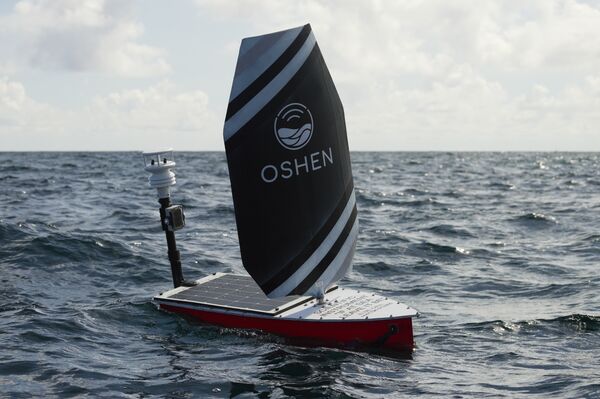
On 28 September 2025 a sailing robot one metre long recorded an air pressure of 955 millibars in the western Atlantic. That reading, plus a jump in the sunlight hitting its sensors, told the team in Devon it had passed through the eyewall of Hurricane Humberto.
NOAA's Atlantic laboratory called it "the first uncrewed surface vehicle to capture and transmit data from inside a Category 5 hurricane". The National Hurricane Center published the 955mb figure in a public advisory that afternoon, noting gusts to hurricane strength at an anemometer height of about half a metre.
Humberto peaked at 140 knots with a central pressure around 918 millibars. The Hurricane Center's final report on the storm, published in December 2025, said observations from Oshen's C-Star vessels "were also helpful in constructing the best track".
The Times reported on 20 August 2026 that Oshen has raised roughly $5m from deeptech backers to roughly triple its fleet. Companies House shows resolutions filed on 14 July 2026 covering an allotment of securities, removal of pre-emption rights and subscription agreements dated 19 June 2026 — the standard paperwork of a priced equity round.
Anahita Laverack and Ciaran Dowds met at Imperial College London and incorporated Oshen on 8 April 2022. That same month they won the £10,000 Social Impact Prize at Imperial's Venture Catalyst Challenge.
Then they pooled their savings, bought a 25-foot sailboat and moved onto it at the cheapest marina in the country, because it gave them somewhere to test from. They built on shore and sailed straight out for two years.
The C-Star is a metre long, has a fibreglass hull and weighed about 25kg in its 2024 configuration. A sail moves it, solar runs the electronics, endurance is up to 100 days, and in hurricane configuration it reports every two minutes.
That is roughly one-sixth the size of the uncrewed vessels NOAA had been using. A Saildrone Explorer is 7 metres; the US Navy's Sea Hunter is 40.
In the summer of 2025 the company built 15 C-Stars in six weeks at Turnchapel Wharf in Plymouth. Eight crossed the Atlantic and seven joined NOAA's hurricane campaign, five launched off St Thomas on 31 August from charter and fishing boats.
Three were driven into Humberto at roughly twelve-hour intervals. All three came through the storm minus a few parts, and across the season the fleet made contact with five named storms.
Before the raise came non-dilutive money: £2m from ARIA in February 2025 under its Forecasting Tipping Points programme, and an investment from DEFRA's marine monitoring programme in April 2024.
The defence work is where the fleet gets large. Oshen joined a UK Defence Innovation project in February 2026, led by ZeroUSV with MarineAI and MSubs, in which a 12-metre mother vessel releases C-Stars across about ten square miles to act as a passive acoustic net.
In July the US Navy hung an echosounder off a C-Star's keel and ran it for a fortnight off Cat Island, Mississippi, under a cooperative research agreement. Oshen says a permanently stationed C-Star can do basic year-round monitoring for less than half the cost of a survey vessel charter, which starts above £20,000 a day.
For founders, the useful part is the sequence: grant and prize money for three years, a hardware record set in public by a customer rather than a press release, and equity only after that. The boat at the cheap marina came first.
More: Oshen